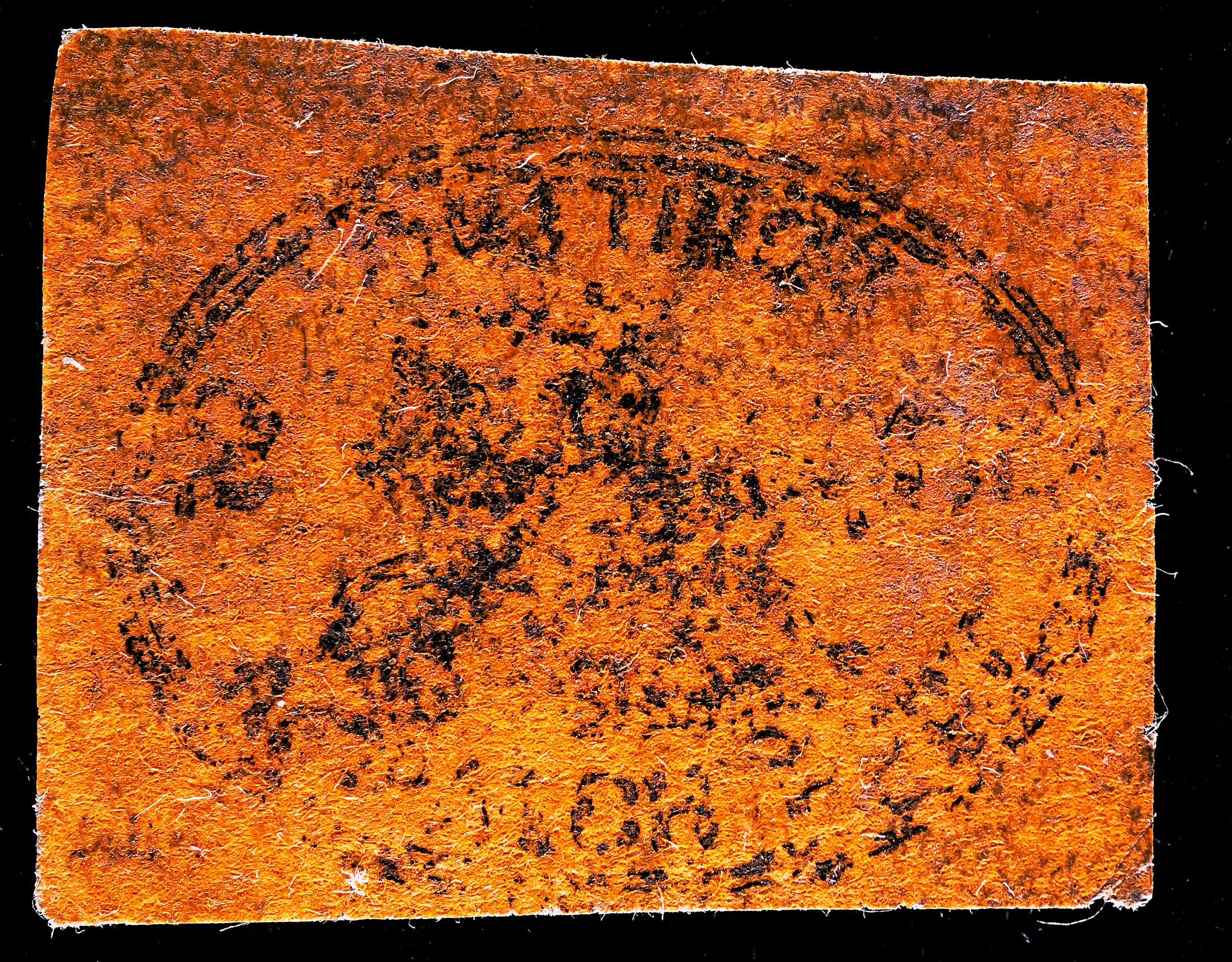
Buffalo’s First Local Post
Thomas S. Cutting, born in 1810 in Sussex County, England, was a prominent Buffalo businessman by the 1840s. His “Intelligence Office and General Agency,” advertised as early as 1845, offered a mix of services: renting properties, collecting debts, arranging employment, and even brokering introductions for marriage. On January 21, 1847, Cutting announced a new offering, Cutting’s Despatch Post, which promised delivery of letters and parcels “to any part of the city” for two cents, and served Buffalo as the town’s first private post.

Local businesses quickly took advantage of the new service. One merchant, E. Hollidge, arranged for Cutting’s messengers to make four daily pickups from his shop on Main Street, ensuring timely distribution of valentines across the city.

Cutting’s Despatch Post is known to have used both a distinctive handstamp and an adhesive stamp. There are only 5 reported examples of the handstamp used, one of which will be offered as Lot 16110 in our upcoming sale:

The adhesive is very similar to the stamp used by Hanford’s Pony Express in New York (78L1). See the side-by-side comparison below:
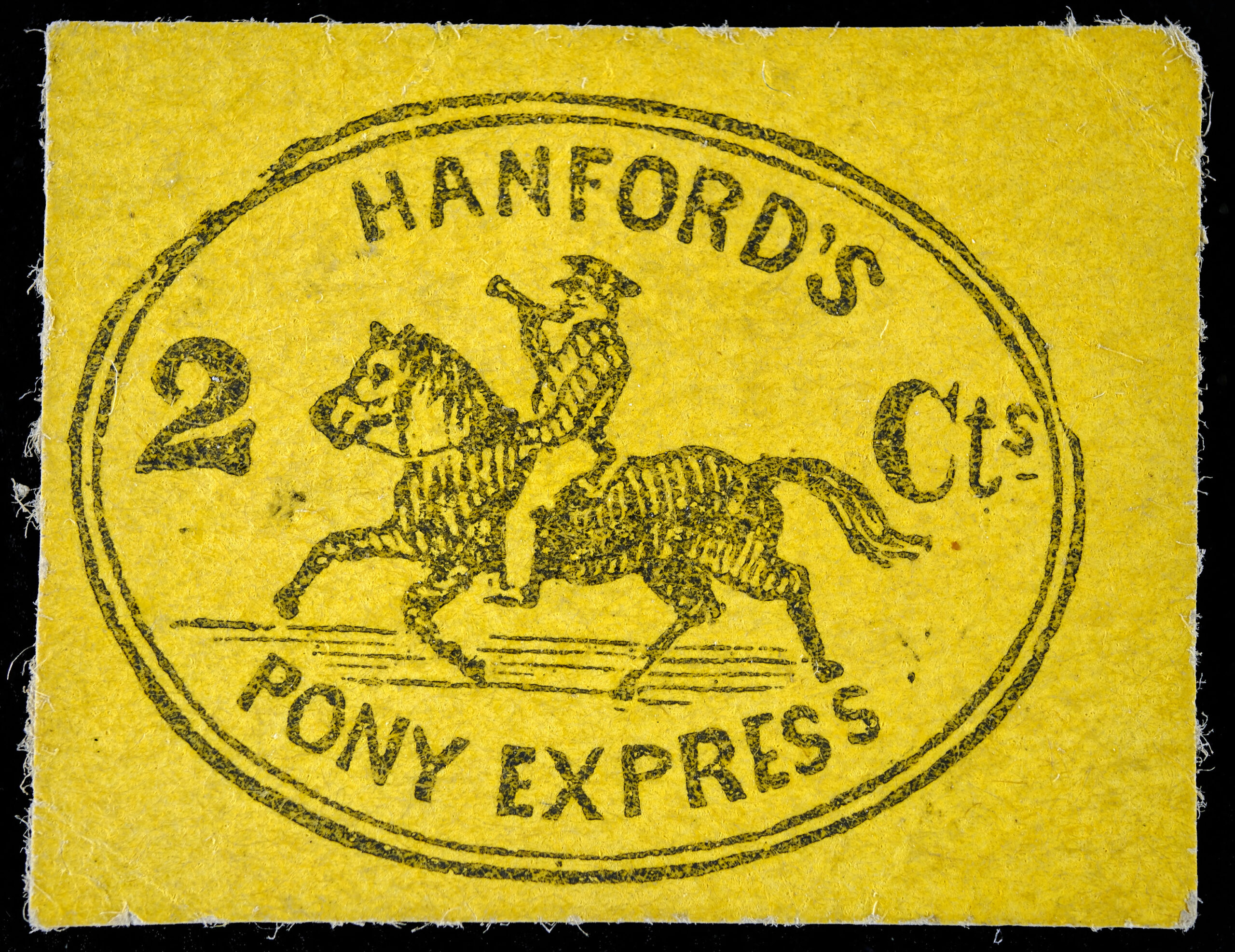
Hanford’s Pony Express 2 Cent Yellow Stamp Unused side-by-side with the Cutting’s Despatch Post 2c Black on Vermilion
What the Philatelic Literature Reported
For decades, the 2c Black on Vermilion adhesive issued by Cutting’s Despatch Post of Buffalo, New York, existed in philatelic literature as a mysterious entry. The first published mention appeared in 1879, when Belgian philatelist J.-B. Moens included it in his Catalogue prix-courant de timbres-poste, but without identifying the post’s city of origin. This was followed by Mitchell’s 1887 Catalogue of the Stamps Issued by the Local Posts in the United States, which listed the stamp but also lacked specifics. A year later, J.W. Scott’s 1888 Descriptive List of Local Stamps erroneously attributed the stamp to New York City.
Despite its presence in these early catalogues, no used or unused examples were known to the authors at the time. Its classification hovered between legitimate issue and phantom listing. That changed when the on-cover example surfaced and was eventually offered in the 1917 Worthington sale.

When Siegel Auctions offered the on-cover example in the November 14–16, 1999 sale of the David Golden Collection of U.S. Carriers and Locals, they noted:
“Sloane’s records contain an enlarged photograph of a rectangular-cut, off-cover stamp, which appears to be a poorly printed example of 56L1; however, there is no other record of this item, its provenance, whereabouts or confirmation that it even exists.”
In his comprehensive his article Private Local Posts in Buffalo, N. Y., Pitt Petri documented five handstamped covers of Cutting’s post and noted the cover bearing the adhesive as the only confirmed usage.
Donald Patton also reviewed the available evidence in his detailed study of U.S. locals, affirming that while the adhesive had been recorded in the literature for over a century, the only example known with certainty was the one on cover. Like Sloane, Patton mentioned the rumored off-cover stamp but could offer no further substantiation.
The Off-Cover Example First Surfaces
In November 2000, an adhesive matching the description of the elusive adhesive surfaced in the Hall Collection sale of Carriers, Locals & Western Expresses. The item was described as the same one pictured in Sloane’s records and noted to have been acquired from Charles J. Phillips in 1926. At the time, it was offered “as-is,” without expertization, and it quietly disappeared from public view for decades.
In April of 2001, the stamp was authenticated by the Philatelic Foundation as genuine, Certificate #365975. In turn, a long-standing philatelic mystery was quietly solve: the stamp does exist, it is indeed genuine, and it remains the only known unused, off-cover example of Cutting’s Despatch Post.
An Elusive Local Stamp Returns After Nearly Two Centuries
Despite its authentication in 2001, the stamp was never publicly exhibited, reoffered at auction, or documented in the philatelic literature. For nearly a quarter-century, its whereabouts remained unknown, and its significance largely forgotten.
For 25 years, this elusive local stamp has gone under the radar. It will now resurface as Lot 16111 in our Summer 2025 auction. For collectors of Buffalo postal history, local posts, or classic United States issues, this is a historic offering.
Be sure to register to bid in our Summer 2025 auction, where this remarkable Cutting’s Despatch Post stamp will be featured alongside 930+ other exciting lots of U.S. stamps and postal history.