A Superb Gem 100: America’s First Stamp
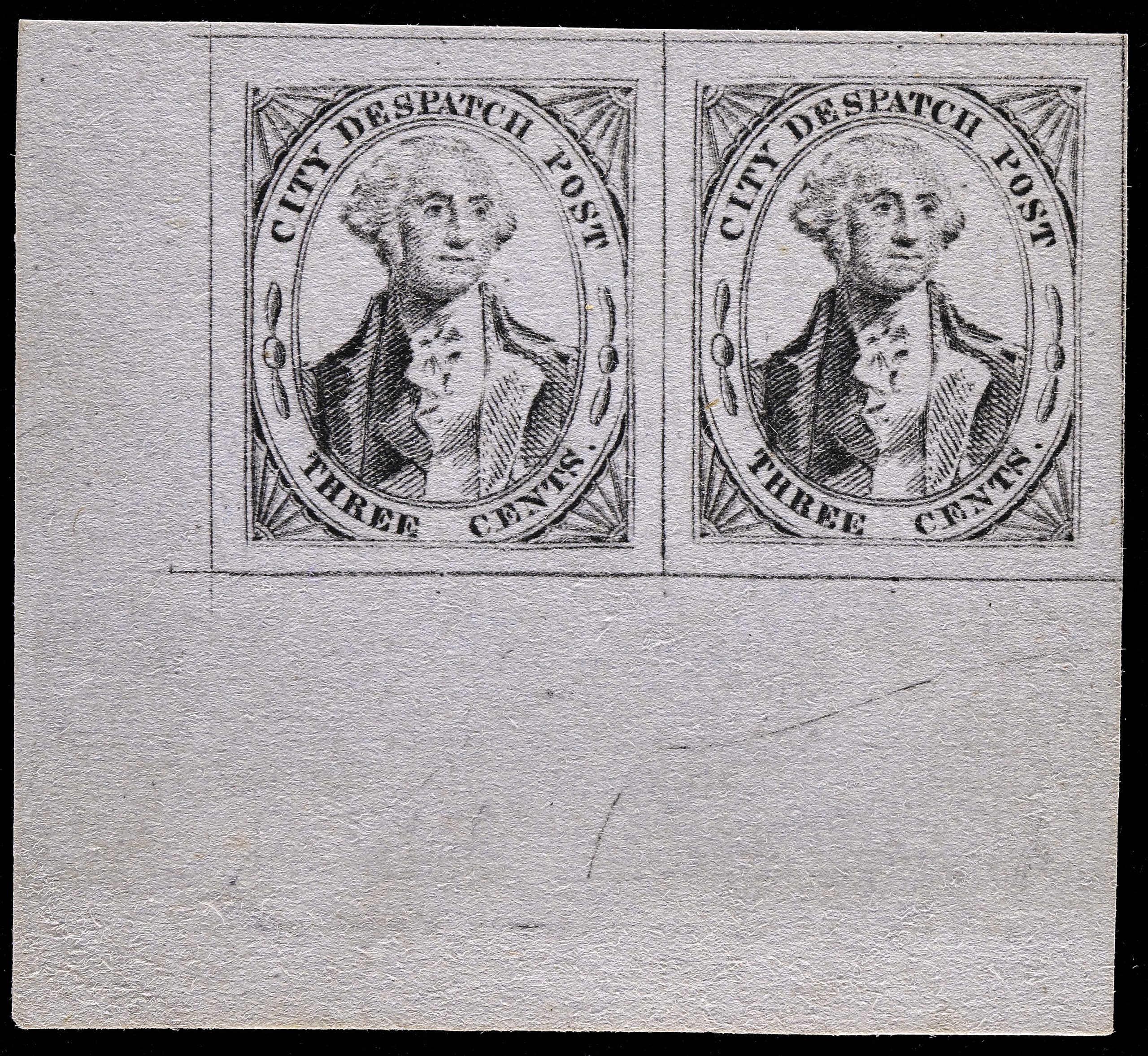
We’re excited to announce that Lot 16087 in our Summer 2025 Auction has just been graded Superb Gem 100 Jumbo by the Philatelic Foundation (PF #606265). This unused left corner margin horizontal pair of (Greig’s) City Despatch Post, 40L1, 3c Black on Grayish is now one of only two pairs to receive this exceptional grade. It ranks among the highest-graded examples of the first U.S. stamp ever recorded.
Population Report Insights
Among all known examples of Greig’s City Despatch Post, 40L1, the unused left corner margin pair offered in Lot 16087 is one of only four examples graded 100J (Superb Jumbo) by the Philatelic Foundation. Importantly, it is one of just two pairs to receive this designation.

Similarly, the PSE (Professional Stamp Experts) population data shows that no examples have received a grade of 100 or 100J.

Meroni Provenance
The lower left corner margin pair offered as Lot 16087 comes from the original sheet of 42 sold in the 1952 Meroni Sale, featured in The Evolution of World Posts by Charles F. Meroni. Its origin from this famous sheet makes it even more special for collectors of early U.S. postage.


Photo of Lot 912 from the Charles F. Meroni, United States Postal History Collection, offered by John A. Fox in 1952.
The Origin of (Greig’s) City Despatch Post
Greig’s City Despatch Post adhesive, 40L1, was issued in February 1842. It is the earliest adhesive postage stamp printed and used in the United States and the Western Hemisphere. It predates the 1845 New York Postmaster’s Provisional by three years and the 1847 General Issue by five.

The local post was founded on February 1, 1842 by Alexander Greig, who served as the public face of the operation established by Henry Thomas Windsor. Operating in New York City, Greig’s post gained quick popularity due to its affordability and reliability. The 3c Black on Grayish stamp, printed by Rawdon, Wright & Hatch, showed a portrait of George Washington and was arranged in panes of 42. It became the first adhesive postage stamp in American history.
Transition to Government Ownership

In August 1842, the U.S. Post Office Department purchased the business. They reorganized it as the carrier department of the New York City post office. The original 40L1 stamp remained in use for a short time under government control (reclassified as Scott 6LB1) but was soon replaced.
The new stamp design read “United States City Despatch Post” (Scott 6LB3). It was printed from a new engraved plate of 50 subjects. These carrier stamps remained in use until the post closed in late 1846, with the shutdown announced on November 28, 1846.

Lot 12032 highlights an example of the 6LB3 adhesive, dated October 24 (1842).
Mead and the Return to Private Ownership
On November 30, 1846 , Abraham B. Mead, a former postal clerk, took over the post and relaunched it as the Post Office City Despatch. Mead reused the original plate and altered the denomination from “THREE CENTS” to “TWO CENTS.” This new issue became Scott 40L2. Though Mead’s announcement declared stamps would be available that day, records show that the first deliveries occurred on December 5 and 6.
One of the finest examples from this brief period is Lot 16089. It is the second earliest reported tied usage of 40L2.

Cummings & Wright Take Over
Mead’s tenure was short-lived. By March1847, the business passed to Cummings & Wright, who continued operations, alongside their own Cummings City Post. During the transition, they honored Mead’s 40L2 stamps and introduced their own adhesives, including the 2c Black on Yellow Glazed paper, Scott 55L3.
Lot 16109 is an exceptional example from this transition. It is one of only two recorded covers showing a Cummings’ adhesive in conjunction with the Post Office City Despatch datestamp. The March 25, 1847 postmark confirms that Cummings & Wright were operating the post at that time.

The Cole Issues
In late October 1847, Charles Cole took control of the post. He altered the plate by engraving “C” or “CC” on either side of Washington’s portrait. These stamps were printed on green glazed, grayish, vermilion glazed, and yellow buff paper.

Lot 16096 is one of just 15 known examples (either on or off cover) from this issue, and this one is signed by George Sloane.
See the City Despatch Section in Our Auction
Together, these remarkable items trace the evolution of America’s first adhesive postage stamp from its private origins to its government adoption and eventual reissue under successive owners. For collectors of early U.S. stamps and local posts, our Summer 2025 Auction offers an exciting opportunity to acquire important examples from every chapter of the City Despatch story.
We invite you to view all the listings in the City Despatch Post section of our Summer 2025 Auction.